
MRKT420: 95% of Product Teams Fail to Agree on What a “Customer Need”is. Uncover Unmet Customer Needs with "Jobs Theory"
By Claire Grusin | Ai Statement: Ai was used to edit this post for spelling and grammar, and was not used in any original copywriting.
Welcome to MRKT420!
Hi there! I’m Claire. Thanks for stopping by! My MRKT420 mini-series applies advanced marketing principles to the nuances of the cannabis industry.
With more than a decade of experience in cannabis data and consumer research, I now serve as Marketing Strategy and Consumer Insights Faculty at Oregon State University’s, College of Business, School of Marketing, Analytics & Design. To date, I’ve taught thousands of undergraduate and MBA students, all over the world, about marketing strategy fundamentals. My hope is that this series will bring you and your team a fresh perspective and may even inspire you to ask more questions. Enjoy! Class is officially in session!
what is “jobs theory?”
Research from MIT’s Sloan School of Management found that ninety-five percent of product teams fail to agree on what a customer need is. (Yes, way.) This lack of alignment around the customer often manifests as:
Wasted resources (time and money,)
Fragmented product roadmaps, and
Marketing teams that chase inputs (new product features) instead of underlying consumer need.
Originally the brainchild of Harvard professor Clay Christensen in his book “The Innovator’s Dilemna,” “Jobs to be Done Theory,” (or “Jobs Theory” for short,”) is the idea that people don’t just buy products or services, rather they “hire” them to solve problems in their lives. (They can also fire them.) “JTBD is a lens that reveals the circumstances—or forces—that drive people and organizations toward and away from decisions.”
According to Christensen, marketing and promotion do not automatically create demand, and just because you build it does not mean they will come. Rather, the opportunity to win a new customer is the result of identifying their specific “struggling moments,” and then reducing “friction points” to conversion.
People don’t just do anything.
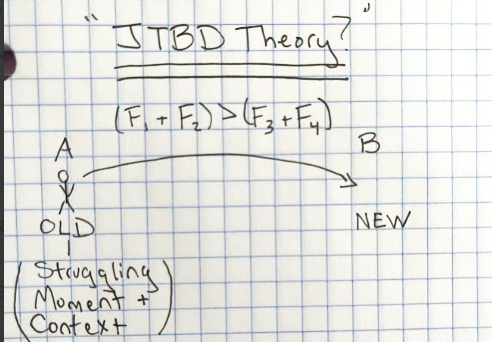
According to, “Jobs Theory,” in order for a person to go from their old way of doing things to your new way they must endure discomfort in the form of a “struggling moment.” Only then can they be receptive your new idea.
Christensen explains that instead, companies often develop products in an echo chamber of their own making. They conduct R&D through the lens of capacity, or in reaction to a rival. “Jobs Theory” asks organizations see the world through the demand side of the equation, instead of the supply side. By focusing on customer needs, Christensen argues the product will market itself.
“Jobs to Be Done (JTBD) is a lens that reveals the circumstances—or forces—that drive people and organizations toward and away from decisions.”
“Jobs Theory” Four Forces:
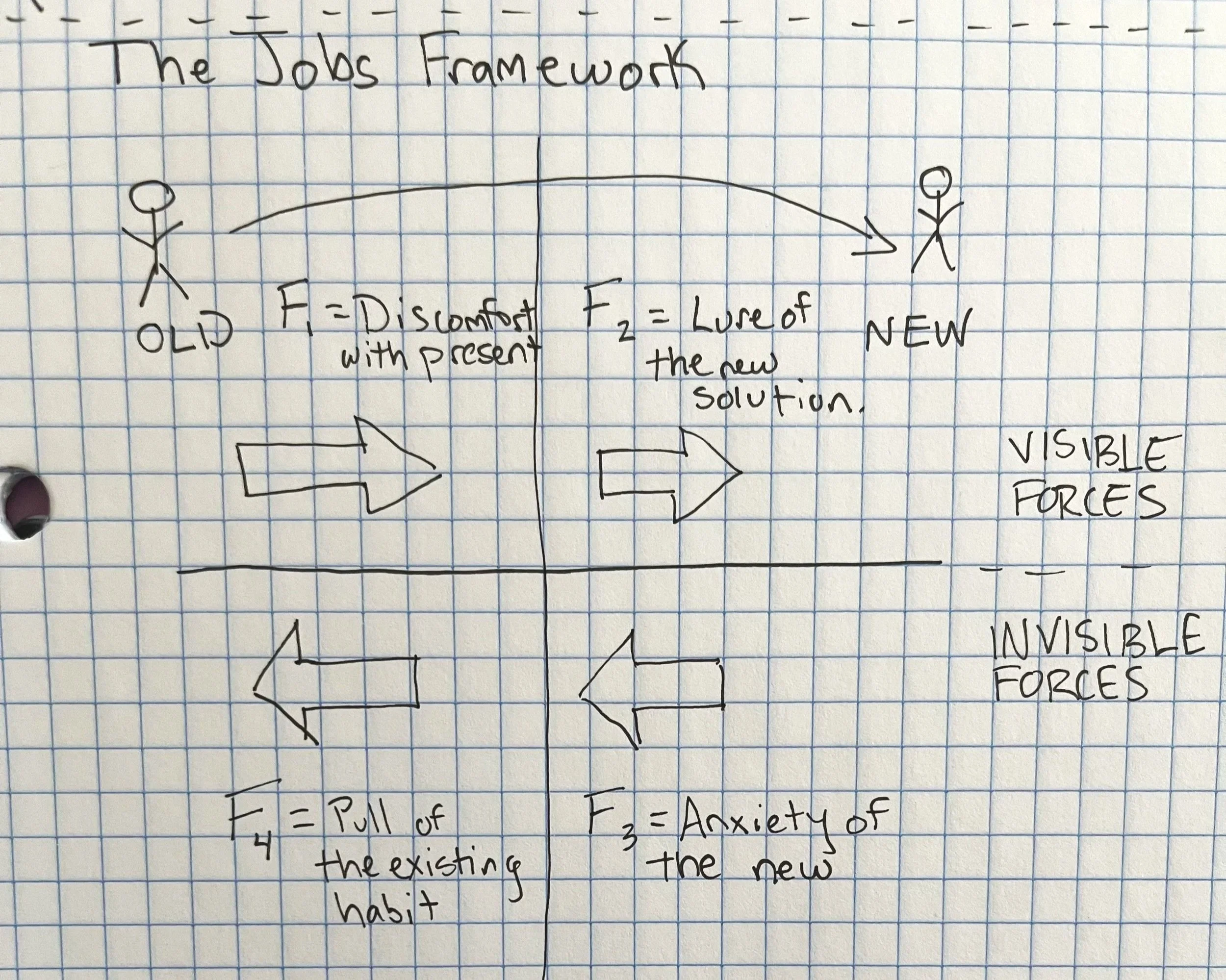
“Jobs Theory” explains that there are four unique forces at play when a person decides to make the leap from their old way of doing things to your new way:
F1 = The discomfort with the present
F2 = The lure of the new solution
F3 = The anxiety of the new
F4 = The pull off the existing habit
“Jobs Theory” teaches us that there are four forces at work that drive people towards and away from change. To get a person change they must endure discomfort in the form of a “struggling moment” (F1) AND that discomfort must be great enough that it creates the context where they open to the “lure of your new solution” (F2). These two forces push the consumer from their old way to your new way.
But, Bob Moesta, co-founder of JTBD Theory and author of “Demand Side Sales,” explains that under the waterline there are two invisible forces at work, resisting change.
“Businesses think that when they introduce a new product, or a new service that it will create excitement, but it doesn’t, it creates anxiety. “Anxiety of the New?” (F3,) Now all of a sudden people are asking themselves, “Can it do all those things? What was wrong with the old product?” And even if everything else is great, the pull of the existing habit can be just too great (F4).”
“Jobs Theory articulates that: (F1+F2)>(F3+F4), or the customer simply will not jump.”
“Jobs Theory articulates that unless (F1+F2) > (F3+F4) then the customer will not jump. It is that simple…” “Jobs enables marketers to be customer centric… Most marketers don’t get it. Marketing isn’t about selling things to people, it’s about meeting them where they are and reducing specific friction points to conversion.”
JOBS THEORY TACTICS:
Moesta argues that to identify your customers (and consumers) “jobs” you have to do the research necessary. “You have to go to where the change is happening. You have to ask the right questions and you have to remain objective.” If you already think you know the answer, then you will bring that bias to the table.
Unsure about your consumers Jobs to Be Done? Unsure who your consumers are or what they even need? Learn more.
Below is one of my all time favorite podcasts on JTBD theory. Lenny’s Podcast with Bob Moesta is shown in every single marketing class I teach. For the best set up to the framework, start at 4:30 and listen through his illustration: